
Thoughts on Akebi's Sailor Uniform
2022-03-28
Why can't we, as a society, be a little bit more normal about girls' bodies?
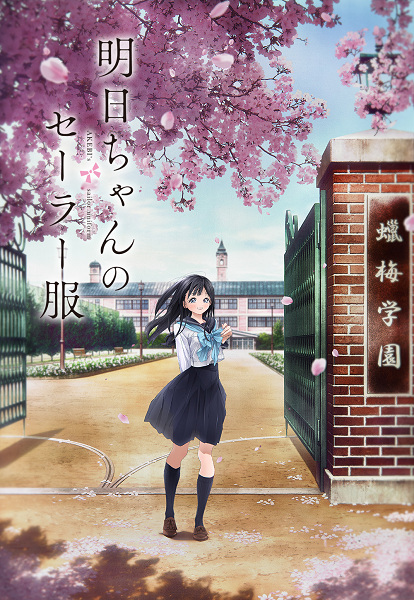
Akebi's Sailor Uniform (Akebi-chan no Sailor-fuku) is a 2022 12-episode anime created at studio Cloverworks based on a manga by HIRO, about first-year middle schooler Komichi Akebi, the only girl at her picturesque country school to wear a sailor-style school uniform, and the little adventures she gets up to with her friends and classmates. Contrary to its innocuous premise, at time of airing it received significant criticism for its excessive interest in the girls' bodies, particularly its love of extended closeups of their feet, lending it a bit of a reputation as, frankly, a show for fetishists. While I don't find these criticisms unjustified, I do think they are, in a sense, insufficient to address what's going on here: Because Akebi's Sailor Uniform is very much a show about bodies, and I find it worth digging deeper into what that means.
Disclosure: I liked the anime a lot! It's a consistently beautiful example of the craft of animation, with tremendous care put in the weight of cloth and hair and subtlety of gesture and expression, some shots so vivid I can practically smell the freshly-washed fabric. Akebi is captured with a litheness and energy that communicates pure joie de vivre. With no prior knowledge of the source material (...more on that in a moment) it likely would not even have occurred to me to see its leg shots as sexual, because I think they serve other purposes. (Big asterisk here is That One Scene in episode 3, which I'll also talk about)
When Akebi tries to sit still at attention, but unable to contain her excitement, she wiggles her little toes under the table, it reminds me of an interview bit with massively influential anime director Naoko Yamada (K-On!, Sound! Euphonium) where she explains: “‘The eyes may be a window to the soul', but I think our legs are like that too. Usually we hide our legs under our desks or else they'll reveal our true emotions.” (Source) Akebi has no interest in hiding anything. Overflowing with life, she presents her body and feelings for all to see, sometimes to embarrassment, but often to affirmation. A recurring plot is for a more shy classmate who feels uncomfortable within herself in some way, through seeing Akebi present the inherent joy and possibility of existing in a body, grow more accepting of herself; Most vividly in episode 10 with her classmate Shijou, who became alienated from her love of tennis after getting hit with a particularly awkward case of puberty and has anxieties about her weight, learning to cheerlead without inhibitions.
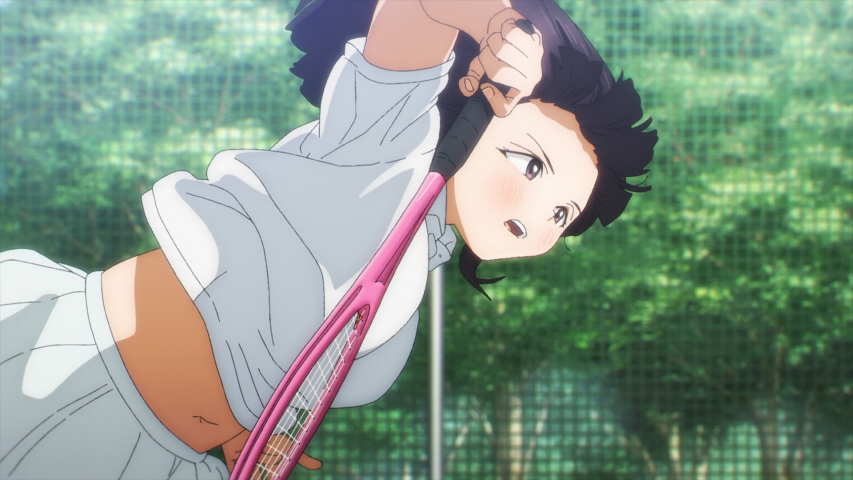
Ganbare, Shijou-san.
Akebi's character designs capture a duality of being simultaneously beautifully presented but also never free of a certain awkwardness, with girls that are 60% torso, eyes as droopy as Dali's clocks and faces that can at times only be described as rhomboid. Its main thrust is to portray the body, no matter what awkward bits it may have, as a powerful tool of expression and connection. It marks Akebi having a quiet moment of emotional connection with her taciturn father with - what else? - a mirroring shot of his feet. For me it brings to mind the 2021 anime Super Cub (the light novel of which HIRO illustrated), which is about a depressed girl discovering the titular motorbike as a tool for expanding her horizons and connecting to others, but where Koguma relies on a Honda® Brand Product to do that work, Akebi argues we already have the means, because having a body is a universally shared fact of being human, regardless of whether you're a pop idol or an insecure schoolgirl or an oafish dad.
It's no coincidence that it's most focused on a part of the body that's often associated with being dirty, shameful, or hidden. What it really wants you to do is stare at your own feet. I think this show can do a lot for a teenage girl viewer who has struggles regarding her body!
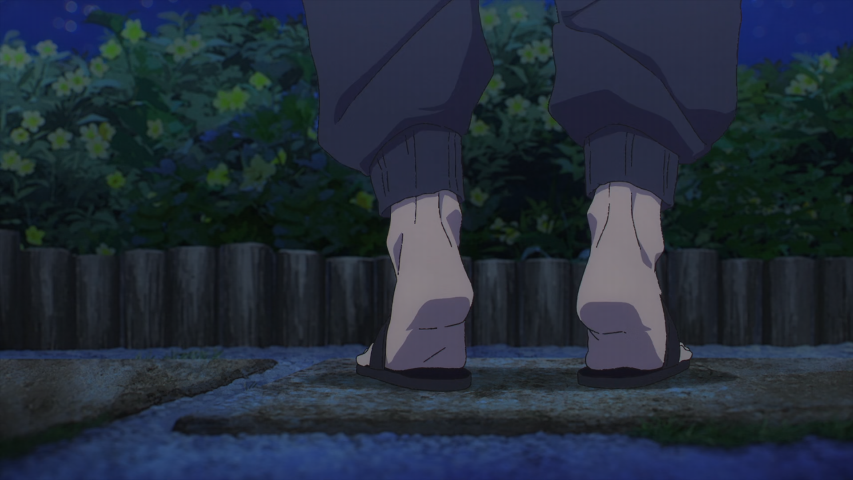
Dad Feet (Highly Sexual)
But there are parts where the show misses the mark, badly. When Akebi walks in on her new classmate Kizaki trimming her toenails in class and then sniffing her feet, it's portraying Kizaki as being a bit of a teenage goblin, but because its visual language is too preoccupied with beauty and sensuality to just let her be that goblin, you get a finished scene that is, frankly, rather bizarre. Episode 3 centers on the inhibited Tanigawa who, after having her legs complimented as beautiful by Akebi and then getting kind of turned on by her physical immediacy, awakens to the idea of being sexually desireable for the first time - very in keeping with the themes of the show, but marked with a loving external camera pan that doesn't so much let us relate ourselves to her as place us as a participant in this 14 year old's sexual voyeur fantasy. It is on-its-face unconscionable, and alone enough to call my entire positive interpretation into question.
So what's happening here? There's no getting around the fact that the source material is much more sexually explicit. HIRO has no qualms about wanting you to look at some shapely teenage butt. But just calling the anime an incompletely scrubbed-for-mass-market adaptation of borderline softcore material also fails to capture the truth, because rather than just reducing the wet t-shirt ratio it fundamentally changes the relationship between work and viewer.
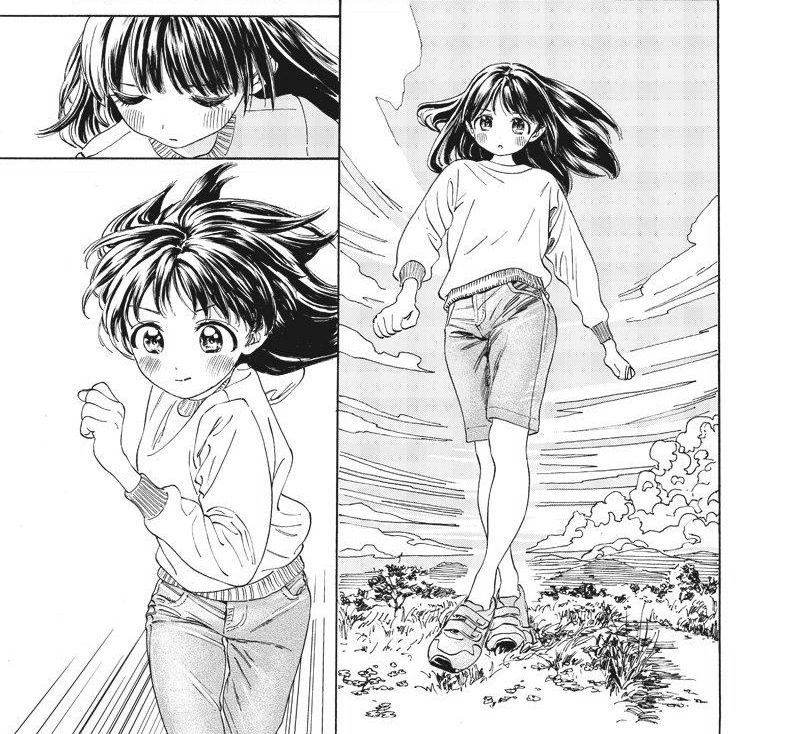
The manga has excellent paneling and artwork. I'd really like it, if it was about, y'know, adults.
The manga is constructed as a kind of gallery of sequential illustrations, inviting you to admire the artistry of Akebi's lovingly rendered booty as a cultured visitor. The anime's framing is more personal and involving: Very telling is the viewer-insert shot in the opening, in which Akebi directly takes the viewer's hand and pulls her along into adventure. I say “her”, because notable is the assumption being made about the viewer's role here: She's specifically portrayed as wearing the beskirted uniform of Akebi's school, being placed in the role of one of her classmates.
The final piece of important context is that unlike the manga author, the anime's head creative staff is almost all women, from director Miyuki Kuroki, to writer Rino Yamazaki, to character designer & chief animation director Megumi Kouno, down to most of the storyboard artists*. Filtered through women's eyes, the story's dynamic becomes one of homosociality.
Akebi's Sailor Uniform is about a girls-only school. Girls-only spaces are interesting because it's precisely the absent expectation of sexuality that allows spontaneous & uninhibited closeness to occur. Paradoxically, that makes them perfect for sexual exploration. When Usagihara offers to swap uniforms with Akebi to try and trick her into stripping in front of the class, it feels like a very authentic moment of teenage boundary-pushing that's only possible in such spaces. When sexuality does appear in the show, it's not in random closeups (after all, girls get close to each other all the time, right, and no one thinks anything of it), but arising unexpectedly and spontaneously in touches that linger a little too long, affectionate gestures that feel a little different for some reason. It's that tension between easy, unquestioned connections and the silent disavowal their possibility is contingent on that also forms the foundation of the yuri genre.
*Episode 3 immediately makes more sense when you realize it's storyboarded by Shouko Nakamura, who's life's mission it is to explore sexuality in animation with varying degrees of lacking subtlety, from the coarse and raunchy Panty & Stocking with Garterbelt to the thoughtful but bombastically all-over-the-place Mawaru Penguindrum. Sakugablog has a great article about her.
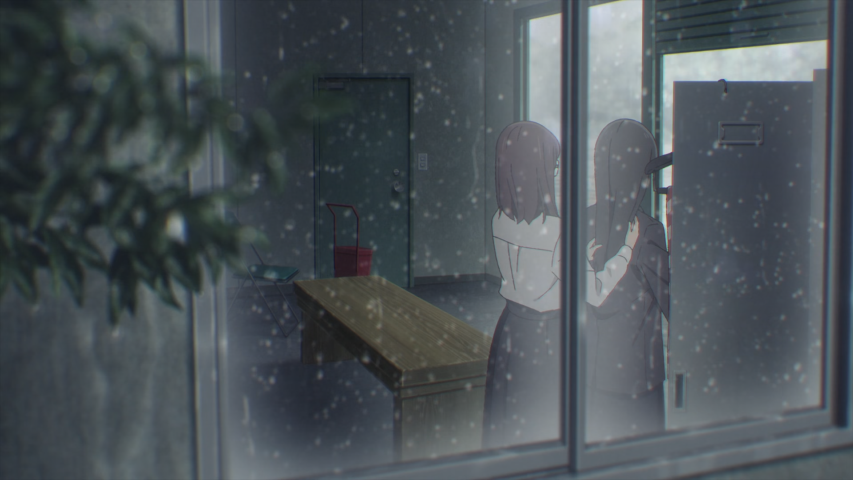
The actual most erotic shot in the show. What I wouldn't give for this team to make an original yuri anime...
So the anime authentically captures that homosocial dynamic right down to its relationship with the viewer, which is all well and good when the viewer is a woman like me waxing lyrical about how it is a balm on my self-image complex, but then I remember that this is a mass-market product viewed by all sorts of people and things get messy very fast. Art changes depending on what the viewer takes into it, and these are not emotional spaces that can stay intact when met by someone either seeking or bracing for sexualization. The staff must've been plenty aware of this, but it's hard to gauge what conclusions they came to about it. The charitable read is that they wanted to make a story that'd make their inner teenage girl happy and didn't want to compromise on that just because somebody might find it sexy. The nastier read is that the show is deliberately selling the fantasy of access to girls' spaces to people who are excluded from them for good reason. The truth probably cuts across both of these, to an extent.
But in the end it is the cultural idea of girls' bodies being inherently sexual objects itself that so severely restricts the spaces where they can be comfortable expressing themselves, that inevitably fosters complexes and anxieties about their bodies many spend their whole life unpacking. Sometimes I wonder if we've galaxy brained ourselves back into a digital-age puritanism in which we must react appropriately scandalized when we see a girl showing too much ankle. It's hard to ask for charitability given anime's long and ongoing history of using women purely as sexual objects, but I do think sensual portrayals of bodies can communicate so much more than that.
Akebi's Sailor Uniform should be an excellent argument in favor of this idea, but in stumbling over a few poor choices of camera placement and being chained to a bad manga, all it proves is how delicate and volatile any attempt to act on it is. And so, in the end, I only have 2 takeaways from all this:
1. Unless you're a teenage girl with a self-image complex, in practice or in spirit, you should not watch this excellent show.
2. I wish we, as a society, both on the end of media creation and the end of media consumption, could just be a little bit more normal about girls' bodies.
